




In a constantly evolving world, organizations deploy changes to SAP systems at the speed of business without compromising security, quality, or compliance. DevSecOps is a methodology to accelerate delivery while ensuring changes are tested and approved before reaching production.
Historically, achieving DevSecOps in SAP landscape was difficult due manual processes, disconnected tools and limited enforcement capabilities. Today, with Rev-Trac as a DevSecOps orchestration layer; organizations can achieve auditable enforcement the entire toolchain while migrating changes with speed.
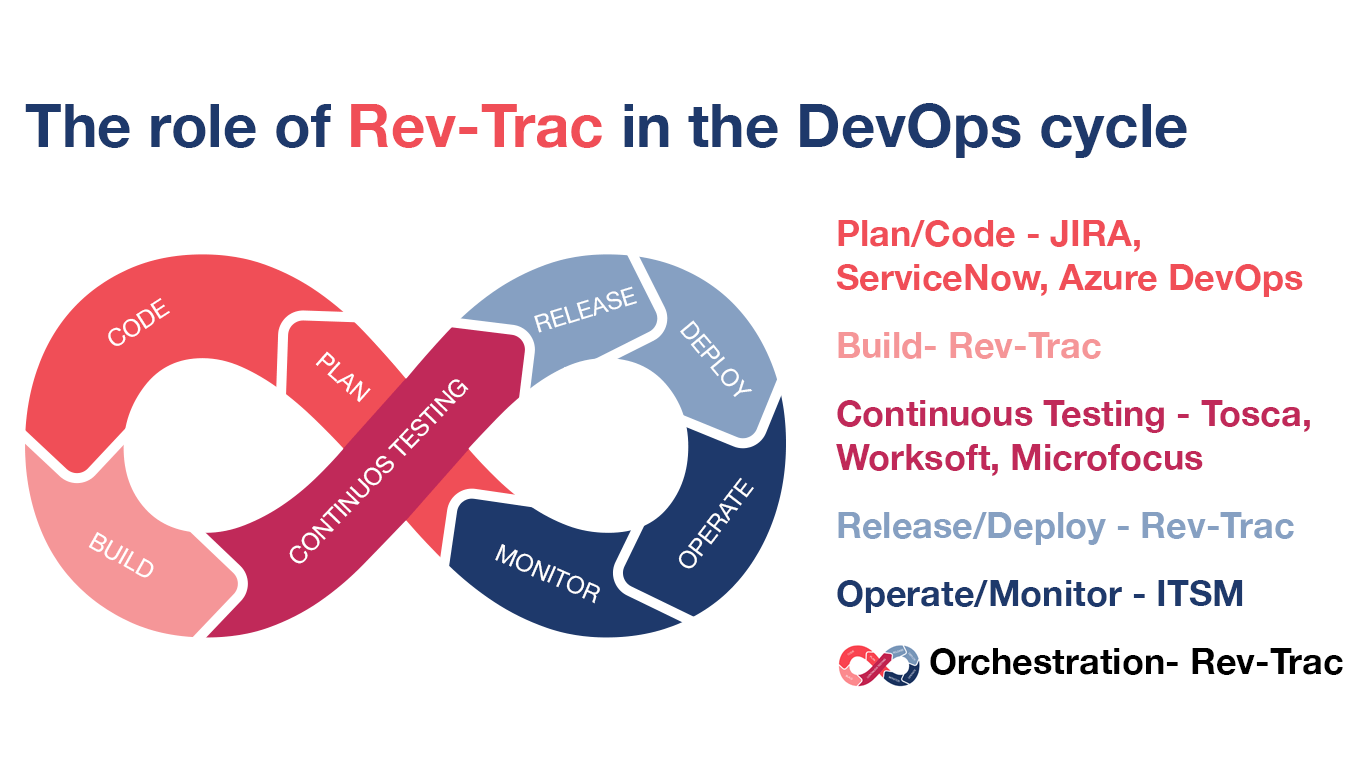
Why enforcement is critical in SAP DevSecOps
When managing SAP changes, enforcement is what turns documented processes into real-world control.
Using Rev-Trac, SAP teams can enforce internally defined change management workflows, ensuring that every change follows documented processes. So, when it comes to compliance, this makes for incredibly happy internal and external audit teams.
This level of enforcement provides full traceability and confidence that only approved, tested changes reach production.
Automating SAP change workflows with Rev-Trac
Rev-Trac simplifies SAP change, creating an automated workflow that eliminates manual tasks and guarantees standard processes are followed.
How enforcement works
Enforcement ensures that changes make it to production only when the correct documentation, approvals and testing are complete. Using native SAP functionality (such as BADIs), Rev-Trac intercepts transports and forces them all to be added to a Rev-Trac Request to move through the landscape.
Example: Enforced SAP DevSecOps workflow
A Rev-Trac workflow can enforce business requirements such as:
- Documentation regarding the change attached before development begins
- Confirmation of ITSM ticket or User Story approval before development finishes
- Integration of code review steps automatically triggered at the right time in the workflow
- UAT and unit testing enforcement with an audit trail available for all approvals of a Request
Improving SAP change quality with automated safety checks
The ultimate goal of SAP IT teams is to deliver rapid, low-risk SAP change. Rev-Trac’s enforcement capabilities support this goal by automatically running SAP changes through several critical safety checks before production deployment.
Rev-Trac’s safety checks include:
- Overtake and Overwrite Protection System (OOPS) to prevent accidental out-of-sequence migrations.
- Dependency checks to ensure required objects exist in the target system to prevent generation errors or help to pinpoint high-risk changes.
These checks run automatically or on an ad hoc basis to resolve issues quickly and prevent changes from migrating to Production without appropriate administration authorization and oversight.
SAP change workflow enforcement in complex environments
If your SAP change management workflow is like many organizations, it involves a lot of touch points with numerous people and even ABAP and non-ABAP technologies.
Without integration and orchestration, enforcing process consistency is difficult.
Rev-Trac acts as both an automated SAP change management solution and an orchestration engine, coordinating all tools into a single end-to-end workflow (or toolchain), while enforcing compliance at every step.
This allows organizations to:
- Reduce manual effort and rekeying
- Eliminate errors and enforce consistent processes
- Prevent unauthorized changes reaching Production
- Realize a full ROI on other tools from seamless inclusion in automated workflows
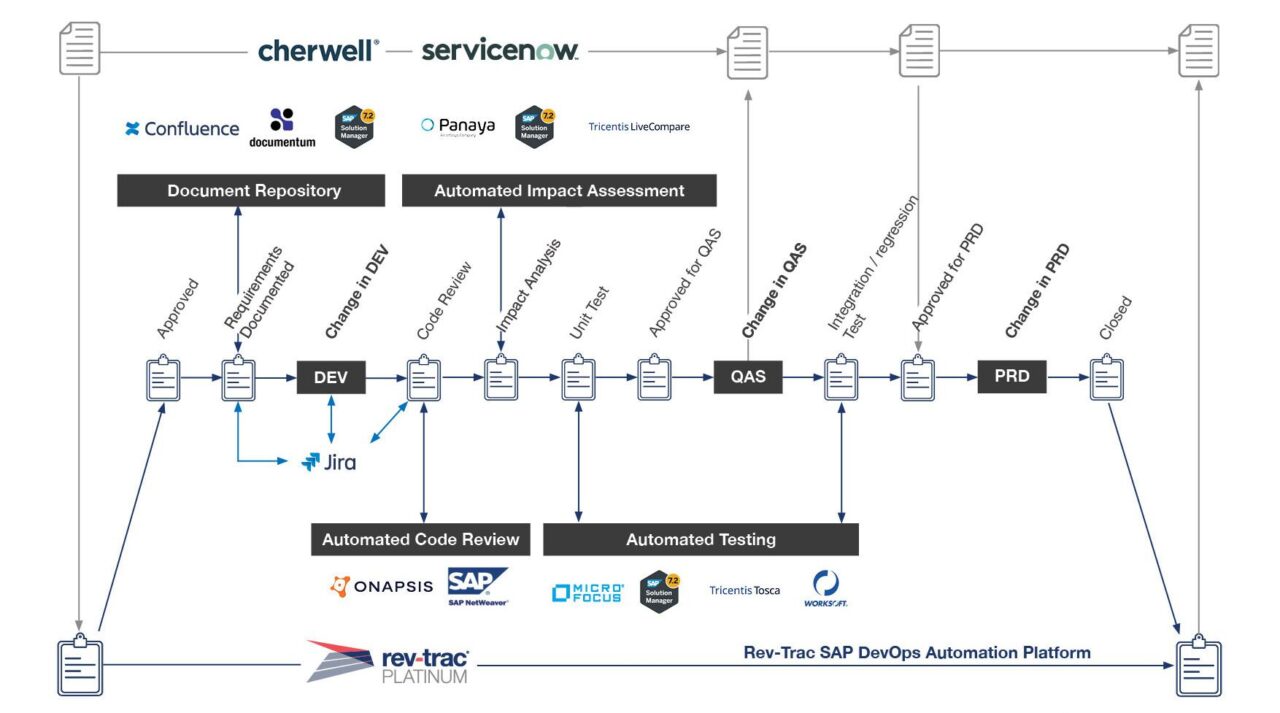
The example above showcases a potential scenario of how Rev-Trac could be used to manage a CI/CD or DevOps toolchain providing rapid release and integrating with other toolsets.
Integrating Rev-Trac into a toolchain enables SAP teams to reduce manual effort and rekeying of work, eliminate errors and enforce process requirements. Simultaneously, organizations can realize a full ROI on the other tools due to their seamless inclusion in automated workflows.
The workflow follows a shift left approach which is important to reduce risk while accelerating change. In a shift left approach, testing and impact analysis happen early so defects can be fixed before a change has progressed significantly.
Applying Rev-Trac in a DevSecOps environment
Rev-Trac acts as the orchestration engine integrating the right security tools into the development workflow and then automating the process without slowing development.
Example DevSecOps workflow
- A business request is created in an ITSM or agile project management solution, triggering the automatic creation of a Rev-Trac Request. As work in SAP begins the Request hits dependencies, which could be a required specification sheet stored as a dynamic link to the document repository. Development continues when all requirements are met.
- After development finishes, Rev-Trac automatically calls the code review tool and enforce pass or fail outcomes.
- On completion, the change is passed to the SAP testing solution which automatically executes the test scripts. If successful, Rev-trac automatically approves the status and attaches the test result. Otherwise, the change is rejected and reverted to developers for a fix.
- Changes which pass the required tests progress to QAS, and ITSM tickets are updated automatically with the necessary details.
- The ITSM ticket is approved, and the changes are synced to Rev-trac. The Rev-Trac ticket owner or CAB team can approve the change to production.
How Rev-Trac integrations work?
Rev-Trac integrates with popular third-party tools using flexible and secure REST APIs, supporting three integration types:
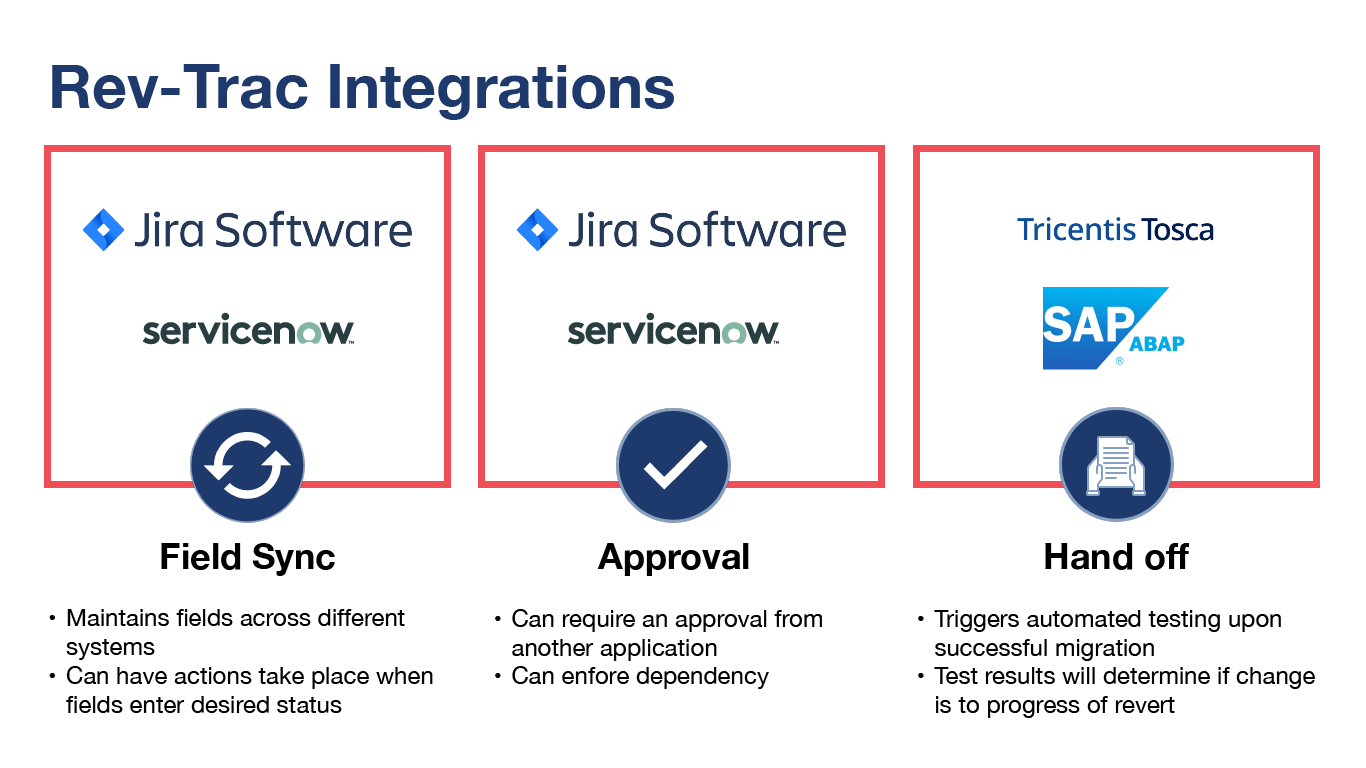
1. Field Synchronization
Keeps data aligned across tools, for example Jira, using REST APIs to push and pull data when it is updated. Rev-Trac is also triggered when a field enters the desired status. For instance, if the Jira status is set to In Progress, a Rev-trac Request can be created.
Both ServiceNow and Jira, for example, use the field sync integration to enable common fields to be maintained across multiple platforms. The sync uses REST APIs to push changes when an update is detected, or a ticket created.
2. Approval integration
This integration allows approvals of certain steps in Rev-Trac from external tools. A popular choice is ServiceNow. Upper management can approve at a CAB level without logging into SAP for approvals. Rev-Trac can hold a migration until a certain status is reached, preventing unapproved changes from reaching production.
Approval based integrations also use REST APIs. However, the focus is on keeping the user in the desired program. For example, the user can stay in ServiceNow and not switch to another program to perform the approval step.
On the Rev-Trac side, fields are updated automatically, and migration or a particular approval step are paused until the external tool provides appropriate approvals. Rev-Trac’s enforcement capabilities ensure the correct use of all toolsets while eliminating double work, such as separate approvals in multiple tools.
You can establish dependencies with other tools in your organization, like ServiceNow. A good example is a dependency on a CAB-level approval from ServiceNow before allowing a deployment to production.
3. Hand-off integration
Rev-Trac passes transports and code using REST APIs to another application for review or analysis and progresses or rejects changes based on returned result. Or it can trigger another event based on the return message.
This integration is useful when determining whether a particular status should be approved. For example, if transports are successfully imported in QA, Rev-Trac triggers a set of tests for Tosca to execute.
Rev-Trac automatically progresses the changes and associated transports if there are no major failures. Otherwise, changes are sent back to developers for further investigation or issue resolution, ensuring no untested code goes through to production. Managers can be confident that all the correct processes have been followed when a request lands on their desk for approval.
FAQ: SAP DevSecOps and Rev-Trac enforcement?
What is SAP DevSecOps?
DevSecOps is the integration of security early in the development lifecycle. That is, integrating the right security into the development workflow and then automating the process, ensuring development doesn’t slow down.
What is shift left in SAP application development?
Shift left in SAP application develop refers integrating testing, quality checks, and feedback loops earlier in the software development lifecycle (SDLC). Detecting defects earlier allows SAP IT teams to prevent costly Production incidents, sequencing issues, and rework. In complex SAP landscapes, changes often span multiple systems and teams, shifting left significantly reduces SAP change risk while enabling faster, more reliable delivery.
How does Rev-Trac enforce SAP change workflows?
Rev-Trac ensures that your change management workflows are not just documented but followed. It intercepts SAP transports and enforces customized workflows using native SAP functionality, ensuring that changes only make it to production when the correct documentation, approvals and testing are complete.
Can Rev-Trac integrate with existing ITSM and DevOps tools?
Yes. Rev-Trac integrates with tools like ServiceNow, Jira, and automated testing solutions, including Tricentis Tosca, using secure REST APIs.
Does enforcement slow down SAP delivery?
No. Rev-Trac automates and orchestrates SAP change workflows, allowing SAP IT teams to deliver changes faster while reducing risk.
Bottom Line: Automation and enforcement are the foundation of SAP DevSecOps
When combined into a DevSecOps toolchain, automation and enforcement enable SAP teams to deliver fast, tested, and secure changes with confidence. With Rev-Trac enforcing workflows and orchestrating integrations, change managers have assurance that all tools and safety checks have been performed before the change reaches Production.
For more information on Rev-Trac’s capabilities to enhance SAP DevSecOps journeys contact one of our change management experts.
To lean how Rev-Trac can enhance your SAP DevSecOps journeys contact one of our change management experts.